What is GSM?
GSM stands for Global System for Mobile Communications. GSM is a cellular network technology that uses SIM cards to store user identity and number.
Because it uses a SIM card, GSM users can move their phone number to another device simply by moving the SIM card.
GSM was widely used on 2G networks and became the foundation for the development of cellular networks such as 3G, 4G LTE, and 5G.
Some operators using GSM technology in Indonesia include Telkomsel, Indosat, XL Axiata, and Tri.
What is CDMA?
CDMA stands for Code Division Multiple Access. This technology uses special codes to distinguish each user within a network.
In older CDMA systems, the phone number was typically tied directly to the device. Therefore, users could not always move their numbers as easily as on GSM networks.
CDMA was once used by several operators in Indonesia, such as Smartfren, Esia, Flexi, and StarOne. However, CDMA networks are now almost entirely unused as operators have transitioned to 4G LTE and 5G technology.
Table of Differences Between GSM and CDMA
| Aspect | GSM | CDMA |
|---|---|---|
| Full Name | Global System for Mobile Communications | Code Division Multiple Access |
| How it works | Divides the network based on time and frequency | Divides the network using special codes for each user |
| User identity | Stored on the SIM card | Generally stored or tied directly to the device |
| SIM card usage | Uses a SIM card | Older CDMA generally does not use a regular SIM card |
| Changing devices | Easy, just move the SIM card | More difficult because the number is usually tied to the device |
| Network coverage | Wider and used in many countries | More limited coverage |
| Operator choices | More | Fewer |
| International roaming | Easier and widely available | More limited |
| Device availability | Many device choices | More limited device choices |
| Voice quality | Good, but depends on the network | Previously known for fairly clear voice quality |
| User capacity | Limited capacity based on frequency division | Can accommodate many users on the same frequency |
| Security | Uses encryption and SIM card authentication | Uses special codes to distinguish users |
| Power consumption | Depends on device and signal strength | In some conditions can be more power efficient |
| Internet speed | Evolved from GPRS, EDGE, 3G, 4G, to 5G | Evolved from CDMA2000, EV-DO, then switched to LTE |
| Current usage | Still used through 4G and 5G networks | Older CDMA technology is almost abandoned |
| Global popularity | Very widespread | More used in certain countries |
| Ease of switching operator | Relatively easy by replacing SIM card | More complicated on older CDMA systems |
| Flexibility | More flexible for users | More dependent on operator and device |
| Example operators in Indonesia | Telkomsel, XL, Indosat, Tri | Smartfren CDMA, Esia, Flexi, StarOne |
Differences in How GSM and CDMA Work
The main difference between GSM and CDMA lies in how they manage users within the network.
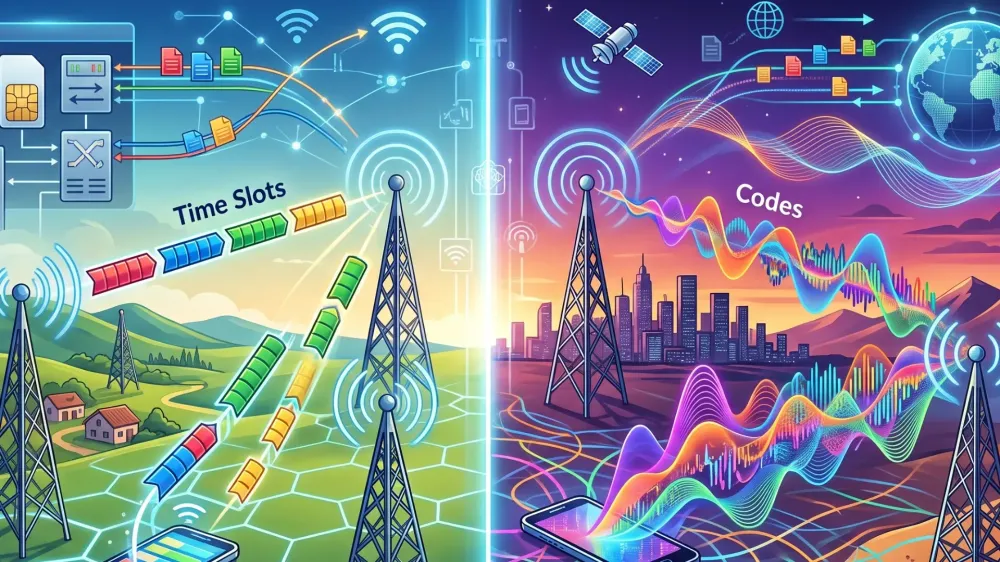
GSM divides communication channels based on time and frequency. Simply put, each user gets a specific portion to make calls or send data.
Meanwhile, CDMA allows multiple users to share the same frequency. Each user is distinguished by a special code so that their signals do not interfere with others.
Although their working principles differ, the goal of both technologies is the same: to connect devices to the operator's network.
Differences in SIM Cards
GSM is known as a network that uses SIM cards. The card stores information such as the phone number, customer identity, and operator network data.
The advantage of using a SIM card is that users can easily switch devices. Simply remove the SIM card from the old phone and insert it into the new one.
In older CDMA, user identity was typically embedded directly into the device. Changing devices often required assistance from the operator.
Some CDMA networks later began using special cards called RUIM. However, their usage was not as widespread as SIM cards on GSM networks.
Differences in Network Coverage
GSM has broader coverage because it is used by most operators worldwide. GSM users also find it easier to get service when traveling abroad.
CDMA has more limited coverage. This technology was once widely used in countries such as the United States, South Korea, Japan, India, and Indonesia.
Due to its smaller global support, CDMA devices often face limitations when used in other countries.
Differences in Signal Quality
The signal quality of GSM and CDMA actually depends heavily on location, number of towers, building conditions, weather, and the number of users on the network.
CDMA was once known for stable voice quality and the ability to serve many users on a single frequency.
However, GSM is superior in terms of network availability. Because there are more GSM operators and towers, users generally find it easier to get a signal.
Nowadays, network quality is more influenced by 4G LTE and 5G technology than by the GSM or CDMA distinction.
Differences in Internet Speed
On GSM networks, internet development began with GPRS, EDGE, 3G, HSPA, 4G LTE, and now 5G.
Meanwhile, CDMA evolved through CDMA2000 and EV-DO technology. At its peak, EV-DO was able to provide fairly fast internet connections.
However, CDMA development did not progress as extensively as GSM. Most CDMA operators eventually shut down their old networks and switched to 4G LTE.
Advantages and Disadvantages of GSM
Advantages of GSM
- Wider network availability.
- Easy to change devices by moving the SIM card.
- More operator and data plan choices.
- Supports international roaming.
- More diverse device options.
- Easier to use when traveling abroad.
Disadvantages of GSM
- Signal quality can decrease when the network is too congested.
- On older 2G networks, voice and internet quality were limited.
- Speed heavily depends on location and operator service.
- SIM cards can be lost or damaged.
Advantages and Disadvantages of CDMA
Advantages of CDMA
- Can accommodate many users on a single frequency.
- Previously known for fairly good voice quality.
- More efficient frequency usage.
- Interference between users can be reduced through the use of special codes.
Disadvantages of CDMA
- More limited network coverage.
- Difficult to change devices on older CDMA systems.
- Fewer operator choices.
- Limited device options.
- International roaming is more difficult.
- Older CDMA technology is almost entirely unused.
Does Smartfren Still Use CDMA?
Smartfren was indeed known as one of the CDMA operators in Indonesia. However, Smartfren has discontinued its CDMA service and switched to using 4G LTE networks.
This means older CDMA devices can no longer access the Smartfren network. Users must use devices that support 4G LTE or newer technology.
Is GSM Still Used Today?
The term GSM is still often used to refer to operators that use SIM cards. However, modern cellular networks have evolved far beyond 2G GSM technology.
Today, the majority of users use 4G LTE and are beginning to transition to 5G. These technologies are used for internet access, voice calls, messaging, and various digital services.
Thus, although the term GSM remains popular, the technology used daily now is generally LTE and 5G.
GSM or CDMA: Which is Better?
If compared based on current user needs, GSM is superior because of its wide coverage, more operator choices, and ease of use.
However, the comparison between GSM and CDMA is no longer very relevant for choosing a modern cellular network. What matters more today is ensuring that the device supports:
- 4G LTE or 5G networks.
- The frequencies used by the operator.
- VoLTE technology for calls.
- Physical SIM card or eSIM.
- Operator signal coverage at the user's location.
Conclusion
GSM and CDMA are two cellular network technologies with different working principles. GSM uses a SIM card and has broader global coverage. Meanwhile, CDMA uses special codes to distinguish each user within a network.
CDMA once had advantages in capacity and voice quality. However, limitations in devices, operators, and coverage led to its gradual abandonment.
Currently, most operators have shifted to 4G LTE and 5G networks. Therefore, users do not need to focus too much on choosing between GSM or CDMA. Instead, choose an operator based on signal quality, internet speed, package price, and network coverage at your location.