
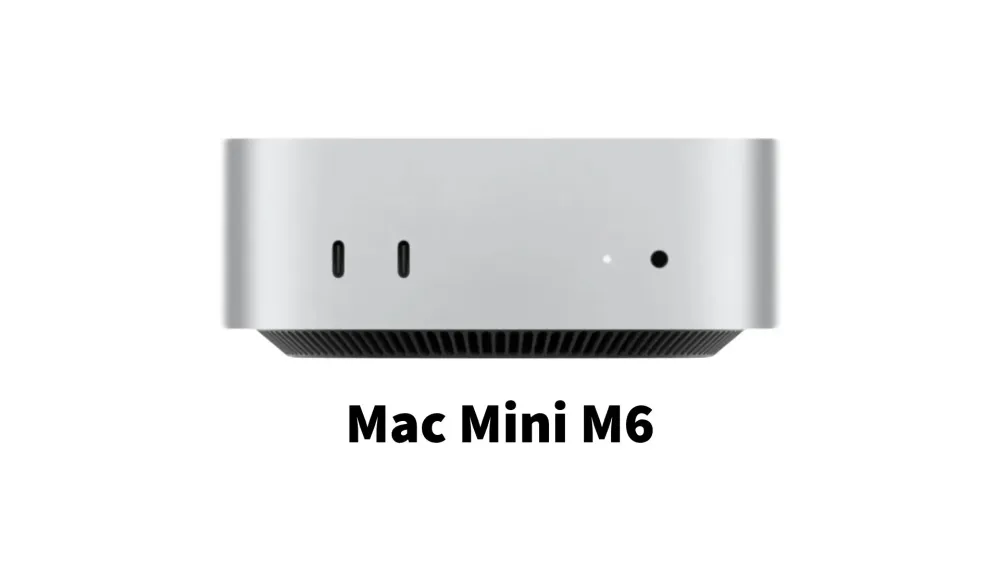
Apple has once again updated its tiny desktop computer with the Mac mini M6. This latest generation was officially introduced on August 25, 2026, and brings substantial upgrades, particularly in the processor, graphics, artificial intelligence, connectivity, and storage speed sectors.
In terms of appearance, the Mac mini M6 still maintains the super-compact design previously introduced with the M4 generation. Therefore, do not expect a drastic change in form factor. This time, Apple has focused more on updating what is inside the device.
The most exciting highlight is undoubtedly the Apple M6 chip. This is Apple's first chip built using a 2-nanometer fabrication process. The M6 brings a CPU and GPU with a higher core count, higher memory bandwidth, and much more serious AI capabilities.
So, how big is the performance jump compared to the previous Mac mini? Here is the complete review.
Mac Mini M6 Officially Introduced by Apple
Apple officially introduced the latest Mac mini on August 25, 2026. There are two chip options available: the Apple M6 for the main model and the Apple M5 Pro for users requiring higher performance.
For most users, the Mac mini with the M6 is the most appealing model. This chip features a 12-core CPU and a 12-core GPU, an upgrade from the 10-core CPU and 10-core GPU configuration available on the M4 Mac mini.
According to Apple, the Mac mini with the M6 delivers up to 40 percent faster CPU performance compared to the M4 Mac mini. Its graphics performance is claimed to be up to twice as fast, while AI-related tasks can run up to four times faster in certain scenarios.
However, keep in mind that these figures are the result of Apple's internal testing and may vary depending on the application, device configuration, and type of workload performed.
M6 Chip Becomes the Main Upgrade
The Mac mini M6 is one of the first devices to use the latest generation of Apple Silicon.
The M6 chip is built using a 2 nm process and features a 12-core CPU consisting of 2 super cores, 4 performance cores, and 6 efficiency cores. This configuration differs from previous Apple Silicon generations as Apple has begun using what it calls super cores to pursue higher single-thread performance.
On the graphics side, there is a 12-core GPU equipped with Neural Accelerators. This technology helps accelerate various tasks utilizing machine learning and AI directly on the device.
Apple also provides a Dual 16-core Neural Engine. Thus, AI processing capability is one of the biggest focuses of the M6 generation.
Unified memory bandwidth also increases up to 170 GB/s on certain configurations. This is important because the CPU, GPU, and various processing units in Apple Silicon share the same memory pool.
For daily use, the difference might not always feel drastic. However, when used for video editing, graphic design, running local AI models, coding, heavy multitasking, or large-scale data processing, the higher memory bandwidth can deliver real benefits.
Complete Mac Mini M6 Specifications
Here are the Mac mini M6 specifications based on Apple's official technical information.
| Specification | Mac Mini M6 |
|---|---|
| Chip | Apple M6 |
| Chip Fabrication | 2 nm |
| CPU | 12-core |
| CPU Configuration | 2 super cores, 4 performance cores, 6 efficiency cores |
| GPU | 12-core |
| Neural Accelerator | Available on GPU |
| Ray Tracing | Hardware-accelerated ray tracing |
| Neural Engine | Dual 16-core Neural Engine |
| Unified Memory | Starting at 16 GB |
| Unified Memory Options | 16 GB, 24 GB, up to 32 GB |
| Memory Bandwidth | 153 GB/s on certain configs, up to 170 GB/s |
| Storage | Starting at 256 GB SSD |
| Storage Options | 256 GB, 512 GB, 1 TB, up to 2 TB |
| Media Engine | H.264, HEVC, ProRes, and ProRes RAW hardware acceleration |
| Video Decode Engine | Yes |
| Video Encode Engine | Yes |
| ProRes Encode/Decode Engine | Yes |
| AV1 Decode | Yes |
| Monitor Support | Up to 3 external monitors |
| Maximum Resolution | Up to 8K 60 Hz on certain monitor configurations |
| Refresh Rate | Up to 4K 240 Hz on certain configurations |
| Front Ports | 2x USB-C USB 3 up to 10 Gb/s |
| Front Audio | 3.5 mm headphone jack |
| Rear Ports | 3x Thunderbolt 4, HDMI, Ethernet |
| Thunderbolt Speed | Up to 40 Gb/s |
| Ethernet | Standard 2.5Gb Ethernet |
| Ethernet Options | Configurable to 10Gb Ethernet |
| Wi-Fi | Wi-Fi 7 (802.11be) |
| Bluetooth | Bluetooth 6 |
| Wireless Chip | Apple N1 |
| Thread | Supported |
| Speaker | Built-in speaker |
| Color | Silver |
| Width | 12.7 cm |
| Length | 12.7 cm |
| Height | 5.0 cm |
| Weight | Approx. 0.67 kg |
| Max Continuous Power | 155 W |
| Operating System | macOS, with macOS 27 for the latest generation |
| Box Contents | Mac mini and 1.8-meter power cable |
| US Starting Price | US$899 |
| Availability Start | September 22, 2026 |
Support for Up to Three External Monitors
The Mac mini may be small in size, but its monitor output capabilities are not small.
The Mac mini M6 can drive up to three external monitors using a combination of Thunderbolt and HDMI.
For a triple-monitor setup, the device can drive two displays at up to 6K resolution at 60 Hz or 4K at 165 Hz, plus a third display at up to 5K resolution at 60 Hz via Thunderbolt or 4K at 60 Hz using HDMI.
When using only two monitors, one of them can reach resolutions up to 8K at 60 Hz, 5K at 120 Hz, or even 4K at 240 Hz depending on the configuration used.
This capability makes the Mac mini M6 quite flexible for multi-display workstations, ranging from office setups, trading, coding, editing, to creator workstations.
Ports Remain Extensive and Connectivity Is Now Faster
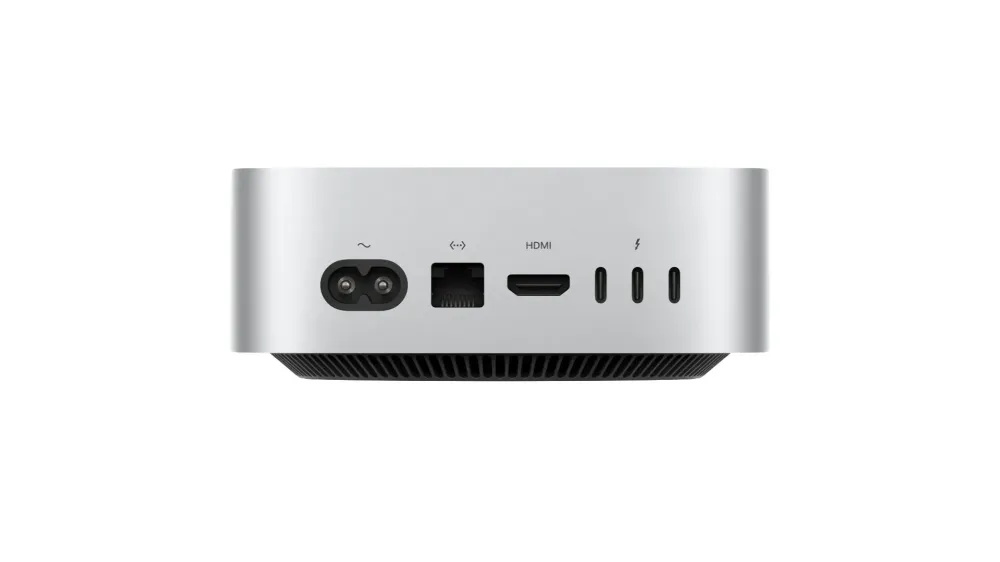
A small design often forces a computer to sacrifice its port count. Fortunately, this is not too much of an issue on the Mac mini.
On the front, there are two USB-C ports supporting USB 3 up to 10 Gb/s and a 3.5 mm headphone jack.
The rear provides three Thunderbolt 4 ports with speeds up to 40 Gb/s, HDMI, and Ethernet.
One quite interesting upgrade is that the built-in Ethernet now utilizes 2.5Gb Ethernet, rather than standard Gigabit Ethernet. Users requiring faster networking can also opt for the 10Gb Ethernet configuration.
Wireless connectivity has also been updated. The Mac mini M6 uses the Apple N1 wireless chip with support for Wi-Fi 7, Bluetooth 6, and Thread.
These improvements might not be immediately noticeable to average internet users, but they are quite useful for local network file transfers, NAS usage, home servers, and professional work environments.
Design Remains Extremely Compact
Apple did not make major changes to the Mac mini's design this time.
Its chassis still measures approximately 12.7 x 12.7 cm with a height of only 5 cm. The weight of the M6 model is around 0.67 kg.
This means the device remains very easy to place on a small desk. In fact, its size is not much different from several Windows-based mini PCs.
This compact design first became one of the biggest changes in the M4 Mac mini. The M6 generation maintains this concept while focusing more on updating internal components.
Users also need to remember that the Mac mini is just a computer unit. Monitors, keyboards, and mice are not included in the package. The box only contains the Mac mini and a 1.8-meter power cable.
Major Focus on AI
One of Apple's primary themes with the M6 is artificial intelligence.
The 12-core GPU now features Neural Accelerators, while the chip also packs a Dual 16-core Neural Engine. The combination of both allows various AI processes to run directly on the device without constantly relying on cloud servers.
According to Apple's testing, processing LLM prompts using LM Studio can be up to 4.8 times faster compared to the M4 Mac mini in certain test configurations. Apple also claims general AI performance can reach up to four times faster.
This makes the Mac mini increasingly appealing not just for office work or editing, but also for developers who want to experiment with local AI, language models, image generation, automation, and local AI agents.
Unified memory of up to 32 GB may not be as large as the M5 Pro model which can reach 64 GB, but it is already quite compelling for various small to medium-sized AI models.
Mac Mini M6 vs. Mac Mini M4
Simply put, this generation's upgrades can be seen in the following table.
| Specification | Mac Mini M4 | Mac Mini M6 |
|---|---|---|
| CPU | 10-core | 12-core |
| GPU | 10-core | 12-core |
| Neural Engine | 16-core | Dual 16-core |
| Neural Accelerator on GPU | Unlike the M6 implementation | Yes |
| Memory Bandwidth | 120 GB/s | Up to 170 GB/s |
| Maximum Unified Memory | 32 GB depending on generation config | 32 GB |
| Standard Ethernet | Gigabit Ethernet | 2.5Gb Ethernet |
| Wi-Fi | Wi-Fi 6E | Wi-Fi 7 |
| Bluetooth | Bluetooth 5.3 | Bluetooth 6 |
| Thunderbolt | Thunderbolt 4 | Thunderbolt 4 |
| Size | 12.7 x 12.7 x 5 cm | 12.7 x 12.7 x 5 cm |
The biggest changes stem not from the design, but from CPU, GPU, AI, networking performance, and memory bandwidth.
Thus, owners of the M4 Mac mini may not have a very strong reason to upgrade immediately if their computing needs remain basic. Conversely, users of the M1, M2, or Intel-based Macs will experience a much more noticeable performance leap.
Mac Mini M6 Price
The Mac mini M6 starts at US$899 in the United States, while educational pricing starts at US$799. Apple opened pre-orders on August 25, 2026, and devices will begin shipping on September 22, 2026, in countries and regions included in the initial launch.
Is the Mac Mini M6 Attractive to Buy?
The Mac mini M6 is an appealing choice for users wanting a fast desktop computer without needing a bulky device.
For tasks like browsing, office work, Figma, coding, Photoshop, photo editing, music production, and video editing, the M6 configuration is likely more than enough for many users.
The CPU and GPU upgrades are exciting, but the most relevant changes for long-term use actually come from Wi-Fi 7, 2.5Gb Ethernet, higher memory bandwidth, and significantly greater AI processing capabilities.
If your work requires heavy 3D rendering, large-scale professional video, complex software development, or running memory-intensive AI models, Apple also offers the Mac mini with the M5 Pro, configurable up to an 18-core CPU, 20-core GPU, and 64 GB of unified memory.
However, for the majority of users, the Mac mini M6 offers a more balanced combination of size, performance, power consumption, and capability.
Conclusion
The Mac mini M6 does not bring a new design, but its internal upgrades are quite significant.
The Apple M6 brings a 12-core CPU, 12-core GPU, Dual 16-core Neural Engine, Neural Accelerators, and memory bandwidth of up to 170 GB/s. Coupled with Wi-Fi 7, Bluetooth 6, 2.5Gb Ethernet, support for up to three monitors, and a body size of only 12.7 cm, the Mac mini remains one of the most compact desktops in its class.
Apple's focus on AI is also becoming increasingly evident. The Mac mini is now positioned not just as a tiny computer for everyday use, but also as a small workstation capable of running various AI tasks directly on the device.
Starting at US$899 in the United States and available starting September 22, 2026, the Mac mini M6 has the potential to be an attractive option for older Mac users looking to upgrade, especially those still using Intel, M1, or M2-based Macs.
Related Articles

Written by
Wilan
A regular contributor to Bali Island Tekno who actively shares knowledge about technology, programming, and the world of software engineering.