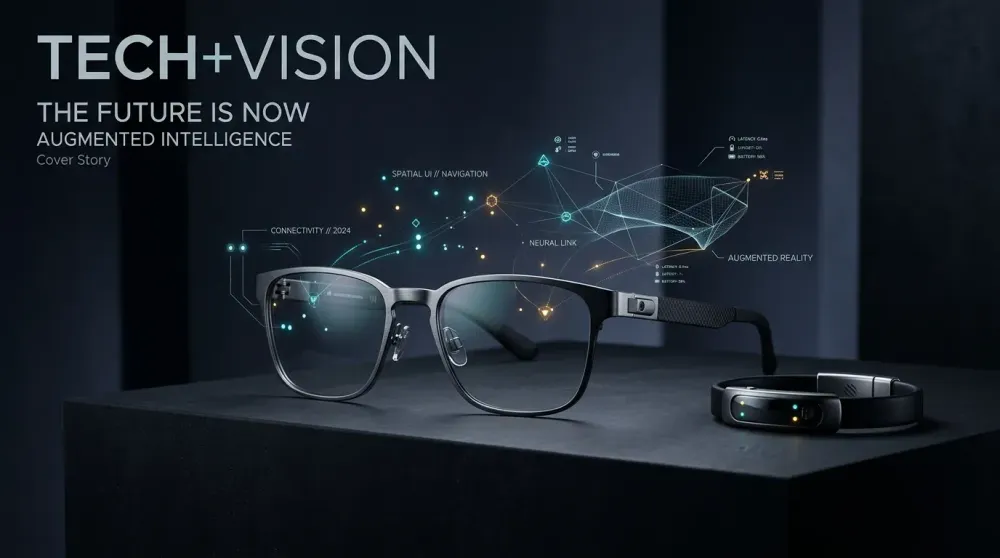
For nearly two decades, smartphones have been the epicenter of human personal computing. Every notification, street navigation, social media interaction, and online information search requires us to bow our heads and gaze at a 6-inch glass screen. However, the consumer tech industry landscape is now on the verge of its most radical paradigm shift: the rise of AI-powered smart glasses driven by multimodal AI and the era of seamless spatial computing (true Augmented Reality) [1, 2].
Driven by leaps in low-latency multimodal artificial intelligence models, advanced optical fabrication, and silicon processor miniaturization, smart glasses are no longer viewed merely as experimental accessories or gimmicks. These face-worn computing devices are transforming into the primary interface that naturally bridges the physical and digital worlds [3, 8].
1. Two Evolutionary Paths of Smart Glasses: Audio/Camera AI vs. True Holographic AR
The current wearable device market is split into two architectural approaches that complement each other but serve different use cases [1, 4]:
                     ┌──────────────────────────────────────────────┐
                     │          SMART GLASSES ECOSYSTEM             │
                     └──────────────────────┬───────────────────────┘
                                            │
                ┌───────────────────────────┴───────────────────────────┐
                ▼                                                       ▼
  ┌───────────────────────────┐                           ┌───────────────────────────┐
  │   Audio & Camera AI       │                           │    True Holographic AR    │
  │   (Display-less / HUD)    │                           │    (Full Spatial Overlay) │
  ├───────────────────────────┤                           ├───────────────────────────┤
  │ • Lightweight (< 50 grams)│                           │ • Waveguide optical lenses│
  │ • POV camera angle        │                           │ • Micro-LED/SiC projectors│
  │ • Open-ear spatial audio  │                           │ • Wide field of view      │
  │ • Multimodal AI Assistant │                           │ • Spatial 3D computing    │
  │ • Example: Ray-Ban Meta   │                           │ • Example: Project Orion  │
  └───────────────────────────┘                           └───────────────────────────┘
a. Audio & Camera-Based AI Glasses (Display-less Assistant)
The first approach sacrifices visual displays to maintain a fashionable form factor, a weight as light as conventional optical glasses (under 50 grams), and all-day wearing comfort [4, 5]. Pioneers in this segment, such as the Ray-Ban Meta collaboration, prove that consumers love screenless devices as long as they are equipped with capable smart assistant capabilities [5, 6].
Glasses in this category rely on:
- Point-of-View (POV) Camera: Capable of capturing photos, recording high-definition video, and live streaming directly from the user's eye perspective [1, 9].
- Multimodal Artificial Intelligence (Vision AI): Users can look at a historical monument, machine code, or a foreign-language restaurant menu and ask verbally, "What does this text mean?" or "What are the steps to fix this cable?". The AI assistant will analyze the camera's visual capture in real-time and provide instant answers through a hidden microphone and speakers [7, 8].
- Open-Ear Audio System: Directional micro-speakers deliver clear sound directly to the ears without blocking the ear canals, keeping users aware of their surroundings [8].
b. True Holographic AR Glasses (Full Spatial Display)
The second approach is the pinnacle of hardware innovation: natural-looking glasses capable of projecting 2D and 3D graphic elements directly over the real world with precision [4]. The most monumental breakthrough is seen in the Project Orion prototype and devices based on the Android XR ecosystem consortium [3, 4, 10].
Unlike regular smart glasses, true AR glasses use lenses made of silicon carbide (SiC) paired with ultra-mini Micro-LED projector engines [4]. This combination produces a Field of View (FOV) reaching 70 degrees—wide enough to display dual digital work windows, interactive three-dimensional object models, and life-sized avatars of interlocutors in the user's living room without requiring bulky headsets that isolate the eyes [4, 10].
2. Human-Machine Interaction Breakthrough: EMG Neural Wristband & New Generation Input
One of the biggest obstacles for smart glasses in the past has been input methods. Constantly tapping the frame feels awkward, while speaking loudly in public triggers social awkwardness.
To overcome these limitations, the industry is shifting toward neuromuscular interface integration: the EMG (Electromyography) Neural Wristband [4, 9].
  [ Movement Intent in Brain ]
             │
             ▼
  [ Arm Motor Neuron Signals ]
             │
             ▼
  [ EMG Sensor Band ] ──(Detects micro-twitches of finger muscles)
             │
             ▼
  [ Smart AR Glasses ] ──(Cursor moves / instant menu selection without large gestures)
- Control Without Visible Movements (Subtle Gestures): The EMG smart band reads electrical motor nerve signals sent from the brain to the wrist and finger muscles [4, 9]. Even before fingers make a full movement, the sensor can detect user intent.
- Combination of Eye Tracking and Pinch Selection: Users simply glance at apps or digital buttons floating in the air using eye tracking, then perform a subtle micro-pinch with their thumb and index finger resting casually on their thigh or pants pocket [4, 10].
- Low-Latency Multimodal Whispering: Directional microphones combined with noise-canceling algorithms (beamforming mic array) allow users to whisper softly without being heard by people next to them, while still being accurately captured by the artificial intelligence system [8].
3. Silicon, Thermal, Optical Engineering, and Social Privacy Challenges
Although the technological potential is very promising, the journey toward mass adoption faces highly complex engineering hurdles [1, 3]:
| Challenge Aspect | Problem Description | Latest Technological Solution |
|---|---|---|
| Power Consumption & Battery | Glasses must be lightweight (< 80 grams), limiting physical battery space to under 300 mAh. | Separation of computing modules (wireless compute puck), sub-miliwatt power-efficient AI chipsets, and wireless fast charging in the charging case [4, 10]. |
| Thermal Dissipation (Heat) | Glasses frames touch human temples and ears directly; even minor heat causes discomfort. | Lightweight magnesium-titanium frames with directed thermal conductivity and offloading processor workloads to edge/cloud computing [4]. |
| Lens Optical Efficiency | Displaying bright images under direct outdoor sunlight (daylight visibility) requires millions of nits of projector brightness. | Use of high refractive index silicon carbide material and energy-efficient Micro-LED projectors [4]. |
| Social Privacy (Glasshole Stigma) | Public concerns regarding secret recording in public areas or restrooms [3]. | Tamper-evident hardware LED indicator lights that automatically cut camera power if the light is covered or removed [3, 8]. |
4. Future Opportunities: From Personal Assistants to the Main Computing Platform
The advancement of smart glasses not only changes daily consumer lifestyles but also transforms professional and industrial productivity sectors [8, 9]:
- Field-Guided Navigation: Directional arrows and building names overlay directly onto the road while walking or driving, eliminating the need to check phone maps.
- Technical & Manufacturing Work: Machine technicians or medical personnel can view wiring diagrams, patient medical records, or step-by-step instructions pinned stably over physical objects being repaired hands-free.
- Cross-Cultural Automated Language Translation: When an interlocutor speaks in a foreign language (e.g., Mandarin or German), translated English text floats smoothly as subtitles beneath their face in real-time [7, 8].
- Contextual Visual Memory (Episodic Memory): An AI assistant continuously observing the environment can answer trivial yet crucial questions, such as "Where did I leave my car keys last?" or "When did I last meet this colleague?" [7, 8].
Conclusion
AI-powered smart glasses and true AR glasses are no longer science fiction from futuristic movies. The transition from smartphones to facial computing devices marks a new chapter where technology no longer distracts us from the real world, but enriches our understanding of our surroundings.
With the refinement of waveguide optical supply chains, EMG neural sensor integration, and strengthened privacy regulations, this decade will witness how smart glasses evolve from mere companion gadgets into the most essential daily computing instruments for humanity.
References & Citations
- Himatika UTY Digital Journal — Perkembangan Tren Wearable AI dan Integrasi Smart Glasses dalam Kehidupan Modern. Source Link
- Deloitte Insights — Physical AI, Spatial Computing, and the Future of Interface Technology. Source Link
- Android XR & Industry Panel — Navigating Privacy, Social Acceptance, and Hardware Trade-Offs in Intelligent Eyewear. Source Link
- MIDO Eyewear Tech Review — Project Orion: The Engineering Breakthroughs Behind Silicon Carbide Waveguides and Neural Interfaces. Source Link
- CNET Hardware Labs — Why Camera-Audio Smart Glasses Succeeded Where Previous HUDs Failed. Source Link
- Consumer Tech Evolution — From Novelty Gadgets to Daily Accessories: The Next Wave of Lightweight Smart Frames. Source Link
- Meta AI Research Group — Multimodal Vision Agents in First-Person Wearable Form Factors. Source Link
- Mashable Tech Analysis — The Rise of AI-First Smart Glasses: How Multimodal Assistants Are Replacing Phone Screens. Source Link
- LiveNOW Fox Technology Brief — Neural Interfaces and Next-Generation Gesture Controls for Wearable Augmented Reality. Source Link
- 180by2 Industry Forecast — The Roadmap to Commercial AR Glasses: Overcoming the Manufacturing Cost Barrier. Source Link