The mobile telecommunications hardware industry (smartphone) has often been criticized for years for experiencing design stagnation. Monolithic glass and metal rectangles have become the standard blueprint that has remained virtually unchanged for over a decade. Although the birth of dual-screen foldable phones (foldables) such as flip and fold models briefly revived the industry's experimental passion, ergonomic limitations and aspect ratios have often forced users to compromise between body thickness when closed and workspace area when open.
A fundamental turning point has just been achieved through the introduction of the world's first commercial triple-fold device, as pioneered by the official launch of the Huawei Mate XT Ultimate Design. The presence of this tri-fold phone proves that pocket devices no longer have to be trapped in the dichotomy of "just a smartphone" or "just a tablet." Through a precise multi-hinge folding system, this device revolutionizes the paradigm of mobile productivity, bringing a full 10.2-inch tablet screen directly from the user's daily pocket.
1. Extreme Mechanical Engineering: Z-Fold Dual Hinge and 3.6 mm Thinness
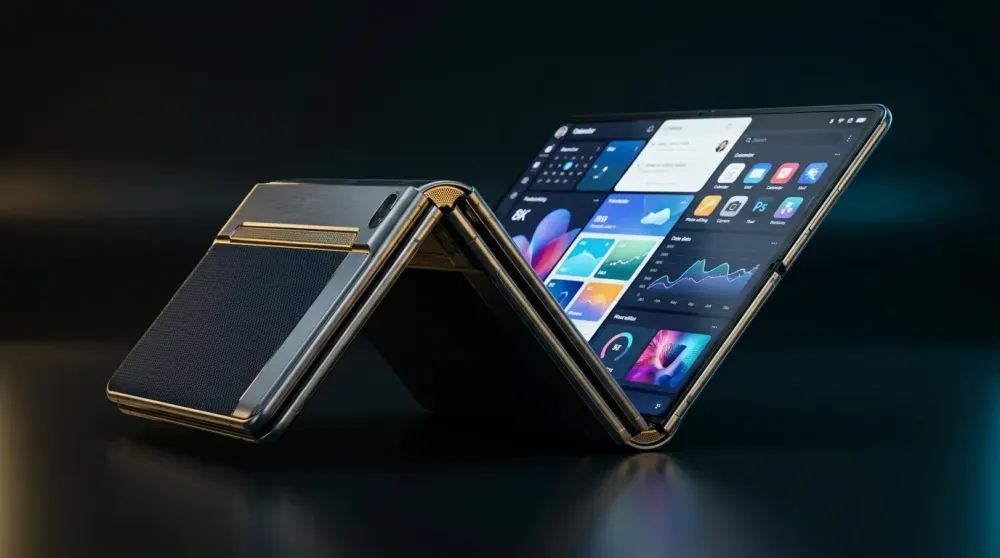
The biggest challenge in realizing the triple-fold phone concept lies not in software provision, but purely in the laws of physics and materials science. Creating a device with three foldable screen panels requires two mechanical hinges working in opposite directions: one hinge folds inward (inward-folding) and one hinge folds outward (outward-folding), forming a zig-zag profile resembling the letter "Z".
Based on mechanical architecture investigations from Notebookcheck, the dual-hinge system named the Tiangong Hinge System uses a combination of ultra-high-strength steel and non-Newtonian liquid metal alloys. This composition allows for an even distribution of mechanical pressure along the folding axis, preventing the formation of permanent creases on the flexible screen.
What is most astonishing to hardware computing engineers is its thinness:
- When fully unfolded (Unfolded 10.2 inches): The chassis thickness reaches only 3.6 millimeters at its thinnest part, making it one of the thinnest digital screen structures ever mass-produced.
- When folded in half (Dual-screen 7.9 inches): Provides a compact square tablet profile that is comfortable to hold with one hand.
- When fully folded (Folded 6.4 inches): The overall thickness is locked around 12.8 millimeters, a very impressive figure as it is still equivalent to early-generation double-foldable phones that only had a single hinge.
2. 3-in-1 Screen Flexibility: Bridging Three User Needs
So far, the weakness of book-style foldables has been their front screens, which often feel too narrow or have an awkward elongated aspect ratio for typing short messages. Conversely, the tri-fold innovation presents three naturally calibrated usage modes:
+-------------------------------------------------------------------------+
|                  THREE OPERATIONAL MODES ON THE TRI-FOLD FORM FACTOR    |
+-------------------+-----------------------------+-----------------------+
| Single Mode       | Dual Mode                   | Full Mode             |
| (Single Screen)   | (Dual Screen)               | (Triple Screen)       |
+-------------------+-----------------------------+-----------------------+
| Size: 6.4 Inches  | Size: 7.9 Inches            | Size: 10.2 Inches     |
| Resolution: FHD+  | Resolution: 2K              | Resolution: 3K (3184x)|
| Ratio: Phone Std  | Ratio: Square (E-reader)    | Ratio: Tablet Format  |
| Focus: Chat Reply | Focus: Doc/Browser Reading  | Focus: PC Workstation |
+-------------------+-----------------------------+-----------------------+
As noted in the technical specifications of the HUAWEI X-True Display, this OLED flexible panel supports a dynamic refresh rate of up to 90Hz as well as high-frequency 1440 Hz pulse-width modulation (PWM Dimming) to prevent eye fatigue.
The shift from a 6.4-inch screen to a 10.2-inch screen is not just about enlarging visuals, but multiplying pixel real-estate. In triple-screen mode, the resolution stretches up to 2232 × 3184 pixels. This active area is equivalent to professional tablets like the Apple iPad or Samsung Galaxy Tab S, yet possesses the unique flexibility to be folded back and slipped into a pair of jeans pockets within seconds.
3. Power Breakthrough: Super Slim 5,600 mAh Silicon-Carbon Anode
One of the conceptual hurdles that caused tech manufacturers to delay the launch of tri-fold phones for years was battery limitations. Powering a 10.2-inch screen requires massive power, while dividing the battery cells into three compartments with a chassis thickness of only 3.6 mm seemed impossible if relying on conventional lithium-ion battery chemistry.
A revolutionary solution came through the implementation of silicon-carbon battery cells. Based on industry reports from Android Central, silicon-carbon technology has a much higher energy density compared to traditional graphite. This allows for the creation of a 5,600 mAh capacity battery with a physical thickness of under 1.9 millimeters per cell.
Charging support is also designed without compromise:
- 66W SuperCharge Cable Charging: Charges the battery from 0 to 70% in less than 35 minutes.
- 50W Wireless Charging: High electromagnetic induction efficiency rarely found in ultra-thin devices.
- Vapor Chamber Thermal Management (Flexible Vapor Chamber): Ensures even heat dissipation to all three body segments without a centralized hotspot.
4. Optical and Photographic Systems Without Sensor Trimming
Typically, thin-profile foldable devices are forced to trim camera module quality to save internal space (such as eliminating periscope telephoto lenses or using small sensors). However, the architecture of this flagship device still combines a high-end optical system.
Referring to the camera review from PhoneArena, this device embeds a 50-Megapixel main camera module with a variable physical aperture (mechanical adjustable aperture) from f/1.4 to f/4.0 combined with Optical Image Stabilization (OIS). In addition to the 12 MP ultra-wide camera, hardware engineers successfully embedded a 12 MP periscope telephoto prism that provides pure optical zoom capabilities up to 5.5x optical zoom.
The ability to place a horizontal periscope module inside a multi-layer foldable chassis is a micro-mechanical engineering achievement that sets a new standard for the global gadget component manufacturing industry.
5. Software Productivity: Reinventing Wide-Screen Multitasking
Stunning hardware is useless if the operating system is not optimized to utilize it. This is where the biggest differentiation lies between conventional double-fold form factors and tri-fold.
On a 10.2-inch screen with HarmonyOS support, users can independently open three full applications side-by-side (three-way split-screen):
- Left Column: Open a Zoom or Google Meet video conference call.
- Center Column: Display an Excel spreadsheet or Google Sheets completely without table cropping.
- Right Column: Run a note-taking app or email client with instant drag-and-drop functions for text and attachments across windows.
When paired with a portable foldable bluetooth keyboard, this phone instantly transforms into an ultra-portable mobile workstation, eliminating the need for business travelers to carry a separate laptop during short trips.
6. Comparison Table: The Evolution of Foldable Phone Form Factors
To understand the generational leap offered, here is a structural comparison between previous-generation foldable phones and tri-fold technology:
| Architectural Parameter | Clamshell Foldable Phone (Flip) | Book-Style Foldable (Dual-Fold) | Triple-Fold Phone (Tri-Fold) |
|---|---|---|---|
| Number of Mechanical Hinges | 1 Inward Hinge | 1 Inward Hinge | 2 Hinges (Inward + Outward) |
| Unfolded Screen Diagonal | 6.7 – 6.9 Inches | 7.6 – 8.0 Inches | 10.2 Inches |
| Unfolded Aspect Ratio | 21:9 or 22:9 (Vertical) | ~1:1 or 6:5 (Near Square) | 3:2 or 16:10 (PC/Tablet Format) |
| Average Battery Capacity | 3,700 – 4,300 mAh | 4,400 – 5,000 mAh | 5,600 mAh (Silicon-Carbon) |
| Thickness When Unfolded | ~6.9 mm | ~4.5 – 5.5 mm | ~3.6 mm |
| Multitasking Scenarios | Maximum 2 Apps | 2-3 Small-Scale Apps | 3 Full Computer Apps Side-by-Side |
7. Production Challenges, Pricing, and Status as a "Halo Product"
Despite presenting a stunning technological leap, the tri-fold innovation faces a series of real challenges before it can be accessed by the general public:
- External Screen Durability Complexity: Because one of the panels always faces outward on the Z-fold, the flexible screen surface is vulnerable to scratches from sharp objects when stored in a pocket or bag without a special protective case.
- Production Yield Rate: Assembling devices that require micrometer precision on two independent hinges has a relatively high initial assembly failure rate in manufacturing plants.
- Ultra-Luxury Segment Premium Pricing: With a global price tag exceeding $3,500 USD, this device operates as a halo product. Its purpose is to demonstrate R&D supremacy, build brand equity, and serve as a stepping stone before component production costs drop to mass economies of scale in the next 2 to 3 years.
8. Future Outlook: The Global Competitor Response Wave
This commercial triple-fold device launch has triggered a domino effect across the consumer tech industry. Global silicon giants and device assemblers such as Samsung Display, Honor, Xiaomi, and Apple are reportedly accelerating their multi-fold patent and prototype programs.
We are witnessing the beginning of the end of the static single-screen monopoly. Within the next five years, the convergence of cloud computing, low-power processors, and triple-fold screens will erase the rigid boundaries between phones, tablets, and laptops. The future of personal computing has arrived—and its form is a triple-fold digital canvas that fits in your pocket.