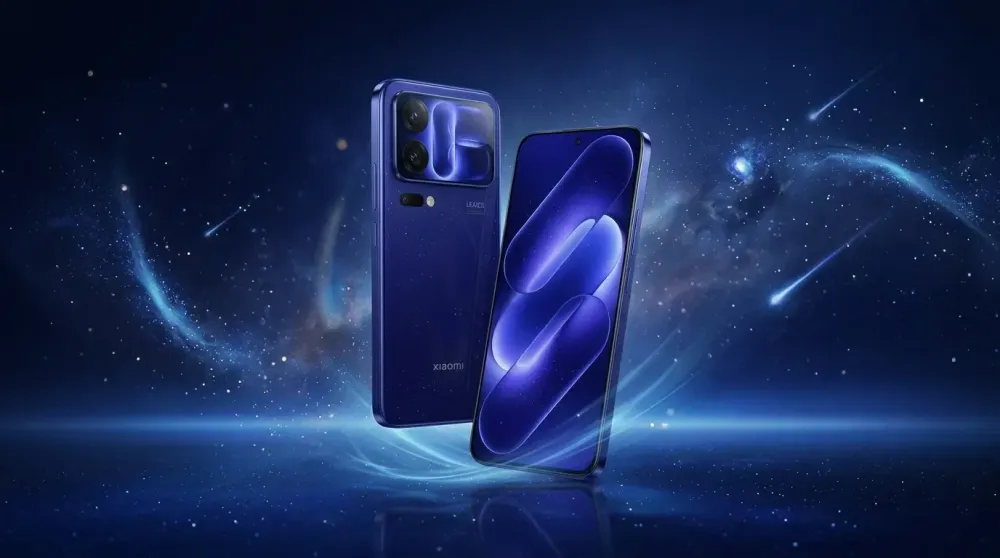
Xiaomi has officially introduced the Xiaomi 18 Pro, and this time the company seems less interested in chasing one headline feature. Instead, it has packed several ambitious ideas into a relatively compact flagship phone.
There is a new 2nm Snapdragon processor, two 200MP cameras, a huge 7,000mAh battery, an additional screen on the back, and even a display designed to make it harder for people beside you to read what is on your screen.
That combination makes the Xiaomi 18 Pro one of the more unusual flagship phones of 2026.
Perhaps the most interesting part, however, is its size. While many high-end Android phones continue getting larger, Xiaomi has managed to fit most of this hardware around a 6.4-inch display. It is not exactly a small phone, but compared with increasingly common 6.8- and 6.9-inch flagships, it feels refreshingly manageable.
Xiaomi 18 Pro Specifications
| Specification | Xiaomi 18 Pro |
|---|---|
| Display | 6.4-inch M11 LTPO OLED |
| Resolution | 2436 × 1120 pixels |
| Refresh Rate | 1–120Hz adaptive |
| Peak Brightness | Up to 4,000 nits |
| Rear Display | 2.7-inch AMOLED, 912 × 596, up to 120Hz |
| Processor | Qualcomm Snapdragon 8 Elite Gen 6, 2nm |
| RAM | 12GB / 16GB LPDDR5X |
| Storage | 256GB / 512GB / 1TB UFS 4.1 |
| Main Camera | 200MP, OIS, Leica Summilux |
| Telephoto Camera | 200MP periscope, 3.2x optical zoom, OIS |
| Ultra-Wide Camera | 50MP |
| Front Camera | 50MP |
| Battery | 7,000mAh silicon-carbon |
| Wired Charging | 100W |
| Wireless Charging | 50W |
| Reverse Charging | Up to 27W |
| Operating System | HyperOS 4 |
| Fingerprint Sensor | Ultrasonic under-display |
| Connectivity | 5G, Wi-Fi 7, Bluetooth 6.0, NFC, UWB |
| Water/Dust Resistance | IP66 / IP68 / IP69 |
| Dimensions | 151.8 × 72 × 8.46 mm |
| Weight | From 203g |
| China Starting Price | CNY 5,999 |
| Release Date | September 23, 2026 |
The Xiaomi 18 Pro is available in China starting from CNY 5,999, with configurations ranging from 12GB + 256GB to 16GB + 1TB. Xiaomi has also confirmed that the 18 Pro series will be released internationally, although exact global markets, dates, and prices have not yet been announced.
A 6.4-Inch Flagship That Does Not Feel Like the "Smaller" Model
There is an interesting change happening in premium Android phones. For a long time, choosing the smaller model usually meant accepting several compromises.
Smaller phone? Smaller battery.
Smaller phone? Simpler camera system.
Want everything? Buy the gigantic Ultra or Pro Max model.
The Xiaomi 18 Pro does not completely follow that formula.
Its 6.4-inch OLED display has a 2436 × 1120 resolution, an adaptive 1–120Hz refresh rate, and a claimed peak brightness of 4,000 nits. Xiaomi has also reduced the bezel around the display to approximately 0.99mm.
At 151.8mm tall and around 203 grams, it should also be noticeably easier to handle than many oversized flagship phones.
And importantly, the smaller body does not force buyers to give up the ambitious camera configuration found on the larger Xiaomi 18 Pro Max.
That could be one of the Xiaomi 18 Pro's strongest selling points.
The Privacy Display Might Be More Useful Than It Sounds
One of the less flashy features may actually become one of the most practical.
Xiaomi has introduced a hardware-level privacy system that reduces visibility when someone tries to view the display from an angle. Privacy protection can also be configured for specific applications and sensitive information.
Think about checking your banking app on a train, replying to private messages on a flight, or entering passwords while sitting in a crowded café.
Normally, the solution would be a privacy screen protector, which often comes with an obvious disadvantage: it can make the screen darker or affect viewing quality.
Integrating privacy directly into the display gives Xiaomi more control over when it is activated.
It is not the type of feature that looks exciting on a specification sheet, but it could become one of those things users appreciate after living with the phone for several months.
There Is Still a Screen on the Back
Turn the Xiaomi 18 Pro around and things get considerably more unusual.
Next to the cameras sits a 2.7-inch AMOLED secondary display with a resolution of 912 × 596 pixels. It can run at up to 120Hz and reach a claimed brightness of 4,000 nits.
The idea of putting a screen beside a camera module is not new for Xiaomi, but the company continues to make it more functional.
The rear display can show notifications, controls, widgets, mini-games, and other information. Xiaomi says more than 100 application cards are supported at launch.
But arguably its best use has little to do with widgets.
A rear display can turn the main cameras into selfie cameras.
Instead of relying on the front-facing camera, users can frame themselves using the small rear display while taking a photo with the much larger main sensor. For group photos, travel shots, and video creators, that can be considerably more useful than simply adding another screen for decoration.
Two 200MP Cameras Is an Unusual Setup
The camera department is where Xiaomi really goes after the numbers.
The Xiaomi 18 Pro uses a 200MP main camera, accompanied by another 200MP periscope telephoto camera and a 50MP ultra-wide camera.
The telephoto offers around 3.2x optical zoom and can focus from approximately 12cm for telemacro photography. Both the main and telephoto cameras also use optical image stabilization.
Having 200 megapixels does not automatically guarantee better photography, of course. Sensor size, lenses, image processing, stabilization, and how the phone handles light are equally important.
What makes the configuration interesting is that Xiaomi is not reserving the high-resolution sensor only for the primary camera.
The telephoto receives similar attention.
That matters because zoom cameras are often where smartphone image quality begins to fall apart. In good lighting, many phones take excellent 1x photos. Zoom in several times, however, and the differences become much easier to notice.
Xiaomi clearly wants the 18 Pro to remain useful after you leave the main camera behind.
There is also a 50MP front-facing camera capable of recording up to 4K video at 60fps.
Snapdragon Goes 2nm
Inside the Xiaomi 18 Pro is Qualcomm's Snapdragon 8 Elite Gen 6, manufactured using a 2nm process.
It represents another generational move toward smaller semiconductor manufacturing, with Xiaomi and Qualcomm emphasizing both performance improvements and better power efficiency.
The phone is paired with either 12GB or 16GB of RAM, while storage options range from 256GB all the way to 1TB using UFS 4.1 storage.
For most buyers, raw speed probably will not be the interesting part anymore. Modern flagship processors are already extremely fast.
Efficiency may matter more.
A chip that can complete demanding tasks while consuming less energy means less heat and potentially better battery life. That becomes particularly interesting when paired with the unusually large battery Xiaomi has managed to fit inside this phone.
7,000mAh in a Phone This Size Is the Bigger Story
The Xiaomi 18 Pro comes with a 7,000mAh silicon-carbon battery.
A few years ago, 5,000mAh was effectively the standard ceiling for mainstream flagship phones. Newer silicon-rich battery technology is allowing manufacturers to increase energy density without making phones dramatically thicker.
That is exactly what makes the Xiaomi 18 Pro interesting.
Its body is only around 8.46mm thick, yet Xiaomi has fitted a battery considerably larger than what used to be normal for a premium smartphone.
It also supports 100W wired charging and 50W wireless charging, so a large battery does not necessarily mean spending hours plugged into a charger.
The real-world endurance will depend on software optimization, network conditions, display brightness, gaming, photography, and many other variables.
Still, combining a 7,000mAh battery with a 2nm processor gives Xiaomi plenty of hardware to work with.
For frequent travelers, mobile gamers, or anyone who simply dislikes watching their battery percentage all day, this could be more important than another benchmark record.
HyperOS 4 Brings More AI Into the Phone
The Xiaomi 18 Pro ships with HyperOS 4.
Xiaomi is also expanding its AI ecosystem through Super XiaoAI 2.0 and its MiMo foundation model. Features include assistance with multi-step tasks, smart-home controls, information management, and communication between Xiaomi devices and computers.
There is even a customizable physical AI button.
However, this is one area where international buyers should wait for the global version before drawing conclusions.
AI services frequently differ between China and international markets because of language support, regional services, partnerships, and software regulations.
The hardware is already known. Exactly how much of Xiaomi's AI experience will carry over to the international edition is the more important question.
Xiaomi 18 Pro Price and Global Release
The Xiaomi 18 Pro launched in China at the following prices:
| Variant | China Price |
|---|---|
| 12GB + 256GB | CNY 5,999 |
| 12GB + 512GB | CNY 6,999 |
| 16GB + 512GB | CNY 7,999 |
| 16GB + 1TB | CNY 8,999 |
Xiaomi has confirmed that the Xiaomi 18 Pro series will receive a global release later in 2026, marking an important change from the previous Pro generation, which remained limited to China. Exact international pricing has not yet been announced.
It is worth remembering that simply converting the Chinese price into US dollars or euros rarely gives an accurate picture of eventual international pricing. Taxes, distribution costs, storage configurations, promotions, and regional positioning can all change the final number.
Final Thoughts
The Xiaomi 18 Pro is interesting because almost every part of it seems designed to challenge the usual compromise of buying a relatively compact flagship.
You still get the flagship processor.
You still get the ambitious camera system.
You still get the large battery.
And you still get some of Xiaomi's stranger experiments, including the screen on the back.
The 200MP numbers will probably grab the most attention, but the 7,000mAh battery inside a 6.4-inch flagship may ultimately be the more meaningful achievement. Add the privacy display and usable rear screen, and the Xiaomi 18 Pro feels less like a phone built around one marketing trick and more like Xiaomi trying several genuinely different ideas at once.
Whether all of them improve the everyday experience will become clearer once the international version arrives.
But on paper, the Xiaomi 18 Pro is shaping up to be one of the most distinctive compact Android flagships of 2026.