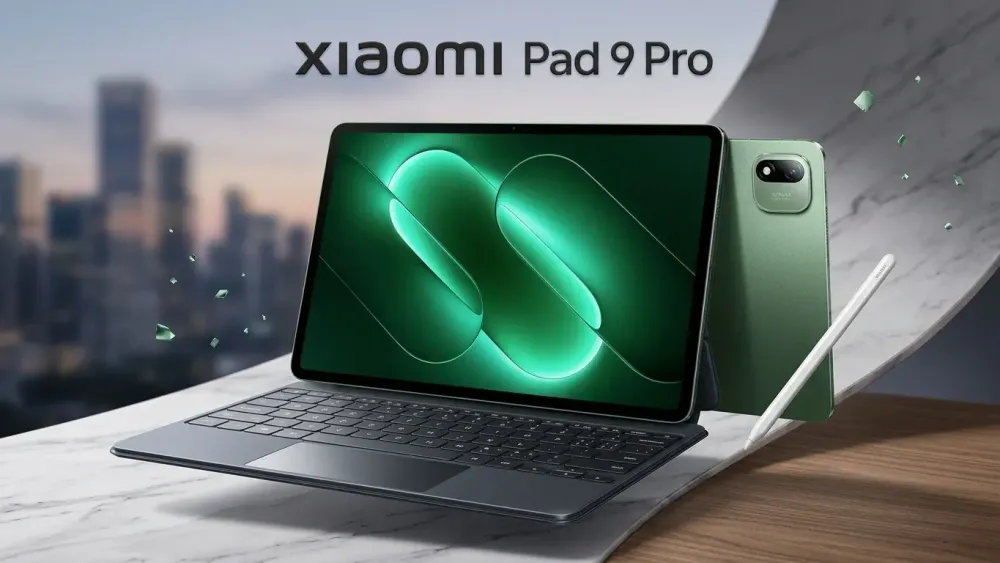
Xiaomi is once again strengthening its premium tablet lineup with the Xiaomi Pad 9 Pro. This latest generation brings noticeable changes compared to its predecessor, particularly the screen size which now reaches 12.5 inches, a larger battery, and the use of a flagship-class Snapdragon chipset.
The Xiaomi Pad 9 Pro was introduced in China in September 2026. This tablet features a 12.5-inch 3.2K LCD display with a 144Hz refresh rate, while its performance is powered by the Snapdragon 8 Gen 5.
Interestingly, Xiaomi seems to no longer want the Pro series Pad to be viewed simply as an Android tablet for watching movies or playing games. The increasingly large screen size, keyboard and stylus support, desktop-class apps, and multitasking system in HyperOS 4 point in a clearer direction: this device aims to take over some of the tasks typically done on laptops.
12.5-Inch Screen is the Most Noticeable Change
One of the biggest upgrades on the Xiaomi Pad 9 Pro is its display.
The tablet uses a 12.5-inch LCD panel with a resolution of 3200 x 2136 pixels, a refresh rate of up to 144Hz, and a peak brightness of around 1,000 nits. Xiaomi also includes support for Dolby Vision, HDR10, and HDR Vivid.
It is indeed slightly interesting that Xiaomi still chose LCD when several premium tablets have begun shifting to OLED. However, this decision does not automatically become a drawback.
For a large tablet that will be frequently used for reading documents, browsing, taking notes, or working for hours, a high-quality LCD panel still makes a lot of sense. The risk of burn-in is practically a non-issue, and Xiaomi also uses DC dimming to control screen brightness levels.
In my opinion, the 12.5-inch size is precisely the most crucial point of this generation.
On a screen of around 11 inches, running two apps side-by-side sometimes still feels a bit cramped. When the size increases to 12.5 inches, opening a browser on one side and a document on the other starts to feel much more natural.
Snapdragon 8 Gen 5 for Heavy Workloads
On the performance front, the Xiaomi Pad 9 Pro uses the Snapdragon 8 Gen 5.
This chipset is accompanied by a graphite-based cooling system with a heat dissipation area of over 22,000 mm². In benchmark testing materials circulating in China, its performance is claimed to surpass the 3.4 million mark on AnTuTu.
Of course, benchmarks are not the only determinant of the tablet experience.
Instead, the benefits of such a fast chipset become more noticeable a few years after purchase. Video editing, playing graphically demanding games, opening many apps at once, and running AI features require significant processing power.
In other words, the Snapdragon 8 Gen 5 might feel like overkill if the tablet is only used for YouTube and browsing. However, for users planning to keep their tablet for three to five years, that extra power can be a quite sensible investment.
RAM Up to 16 GB
Xiaomi offers the Pad 9 Pro in several memory configurations.
The options available in the Chinese market start from 8 GB RAM + 128 GB storage, followed by 8 GB + 256 GB, 12 GB + 256 GB, up to the highest configuration of 16 GB + 256 GB. A Soft Light Edition version is also available in select configurations.
16 GB of RAM is definitely not a necessity for everyone.
However, such a large capacity will come in handy if Xiaomi continues to improve HyperOS's multitasking capabilities. The more apps that can run simultaneously without having to reload, the closer the user experience gets to that of a computer.
HyperOS 4 Focuses More on Productivity
Fast hardware won't be very useful if the operating system still feels like an enlarged smartphone.
Therefore, one of the most interesting parts of the Xiaomi Pad 9 Pro lies in HyperOS 4.
This system supports running multiple app windows at once as well as productivity apps optimized for large screens. In China, Xiaomi is also promoting the PC version of WPS and editing apps like CapCut/Jianying as part of the tablet productivity experience.
The Xiaomi Pad 9 Pro can also be paired with the Focus Stylus Pro and Xiaomi's official keyboard.
This combination of tablet, keyboard, and stylus makes the device more flexible. When relaxing, it can be used like a normal tablet, but when you need to type documents, you simply attach the keyboard.
However, there is one thing to keep in mind. A tablet cannot necessarily replace a laptop for everyone.
Jobs that require specialized desktop applications, development environments, software engineering, or specific enterprise workflows are still more comfortably handled via Windows, macOS, or Linux.
Conversely, for students, light content creators, administrative workers, or people whose work is mostly done through browsers and documents, devices like the Pad 9 Pro are increasingly making sense as a primary device.
11,000 mAh Battery
The larger body size is also utilized by Xiaomi to house an 11,000 mAh battery.
Charging supports 67W fast charging and even reverse charging up to 22.5W, allowing the tablet to be used to charge other devices when needed.
The 11,000 mAh capacity is crucial considering the 12.5-inch screen and 144Hz refresh rate consume a fair amount of power.
Conceptually, a large battery like this also makes the tablet more suitable for use as a mobile work device. Users don't always have to stay near a power outlet when taking the tablet to campus, meetings, or traveling.
Six Speakers for Multimedia
Xiaomi is also quite serious about the audio department.
The Pad 9 Pro uses a six-speaker setup with Dolby Atmos support, an upgrade from the four-speaker configuration of the previous generation. The tablet also features four microphones for video calls and online meetings.
The combination of a large screen and six speakers could be an appealing reason to buy this device, even for users who don't strictly need its productivity capabilities.
For watching Netflix, YouTube, or movies on the go, the provided experience is likely much closer to a laptop than a small-sized tablet.
50 MP Camera and 32 MP Front Camera
Cameras are rarely the primary reason someone buys a tablet.
Even so, Xiaomi still provides a 50 MP rear camera, while the front camera uses a 32 MP sensor. The front camera is positioned along the long edge of the screen, making it more appropriate when the tablet is used horizontally for video conferences.
This approach makes much more sense for a tablet, as the front camera is likely used more often for Zoom, Google Meet, or video calls rather than taking selfies.
Maintains Slimness Despite a Large Screen
Even though the screen and battery have grown larger, Xiaomi has managed to keep the body relatively slim.
The Xiaomi Pad 9 Pro has a thickness of about 5.8 mm and weighs around 580 grams for the standard variant. The body features a metal construction and is available in Black, Spruce Green, and Silver.
At 580 grams, it is actually quite heavy if the tablet is used with one hand for a long period.
However, for a 12.5-inch device, that figure is still quite reasonable. Xiaomi seems to have designed the Pad 9 Pro to be used more often on a desk, paired with a keyboard, or placed on a stand rather than constantly held like an 8-inch tablet.
Xiaomi Pad 9 Pro Specification Table
| Specification | Xiaomi Pad 9 Pro |
|---|---|
| Display | 12.5-inch LCD |
| Resolution | 3200 x 2136 pixels / 3.2K |
| Refresh Rate | Up to 144Hz |
| Brightness | Up to 1,000 nits |
| HDR | Dolby Vision, HDR10, HDR Vivid |
| Chipset | Qualcomm Snapdragon 8 Gen 5 |
| RAM | 8 GB / 12 GB / 16 GB |
| Storage | 128 GB / 256 GB |
| Rear Camera | 50 MP |
| Front Camera | 32 MP |
| Battery | 11,000 mAh |
| Fast Charging | 67W |
| Reverse Charging | 22.5W |
| Speakers | 6 speakers, Dolby Atmos |
| Microphones | 4 microphones |
| Operating System | Xiaomi HyperOS 4 |
| Port | USB-C, USB 3.2 Gen 1 |
| Thickness | Approx. 5.8 mm |
| Weight | Approx. 580 grams |
| Stylus | Supports Xiaomi Focus Stylus Pro |
| Keyboard | Supports Xiaomi external keyboard |
| Colors | Black, Spruce Green, Silver |
These specifications refer to the model introduced for the Chinese market in September 2026.
Xiaomi Pad 9 Pro Price
In China, the price of the Xiaomi Pad 9 Pro starts at 3,799 yuan for the 8 GB + 128 GB variant.
The highest version with 16 GB of RAM and 256 GB of storage is sold for around 4,999 yuan. There is also a Soft Light Edition which uses a special screen treatment and is sold slightly higher.
As for Indonesia, as of September 24, 2026, there has been no official announcement regarding the price or release schedule of the Xiaomi Pad 9 Pro. Therefore, the rupiah conversion from the Chinese version should not be used as a benchmark for the official Indonesian pricing.
Who is the Xiaomi Pad 9 Pro Suitable For?
Looking at its specifications, the Xiaomi Pad 9 Pro sits in a quite interesting position.
This device might be overkill if your primary needs are just streaming and browsing. The regular Xiaomi Pad version or a mid-range tablet would certainly suffice.
However, for students, mobile workers, designers, people who frequently edit content, or users who want to carry a simpler device than a laptop, the Pad 9 Pro offers a quite sensible combination.
The most interesting part isn't even the benchmark numbers.
The shift to a 12.5-inch screen, an 11,000 mAh battery, six speakers, keyboard and stylus support, and a HyperOS that handles multitasking more seriously show that the boundary between tablets and laptops is blurring.