The internet we use today has undergone many changes. Websites from the past are very different from the modern websites we visit every day.
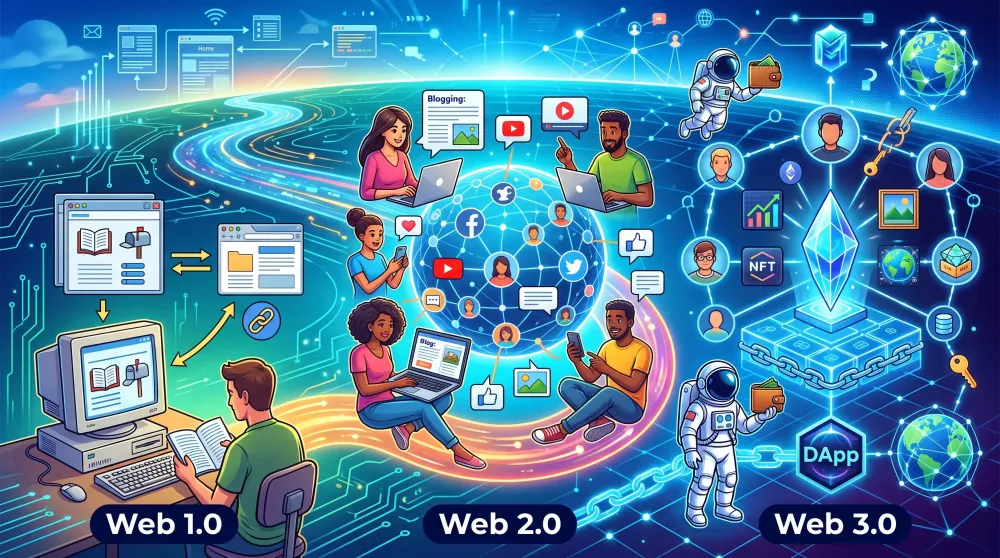
In general, the evolution of the internet is often divided into three generations: Web 1.0, Web 2.0, and Web 3.0.
Each generation brings changes in how we use the internet, from simply reading information to being able to interact, create content, and own digital assets.
What Is Web 1.0?
Web 1.0 is the early generation of the internet that became popular in the 1990s.
During this period, most websites were only used to display information. Visitors came to the website, read the page content, and that was it.
Interaction between website owners and visitors was still very limited.
Therefore, Web 1.0 is often called the Read-Only Web.
Characteristics of Web 1.0
Some characteristics of Web 1.0 include:
- Websites were dominated by static pages
- Visitors only read information
- There were not many comment or interaction features
- Website design was still simple
- Content was created directly by the website owner
- Content updates were usually done manually
An example is a company website from the past that only had Home, About Us, Product, and Contact pages.
There were no user accounts, comments, feeds, or interaction systems like the ones we commonly see today.
What Is Web 2.0?
Web 2.0 is an evolution of the internet that allows users not only to read information but also to interact and create content.
This is the generation we use the most today.
Users can create accounts, leave comments, upload photos, write articles, give reviews, make transactions, and even communicate directly with other users.
Therefore, Web 2.0 is often called the Read and Write Web.
Characteristics of Web 2.0
Web 2.0 typically has features such as:
- Login system and user accounts
- Comments and reviews
- Social media
- Photo and video uploads
- Marketplace
- Online forums
- Booking systems
- Web-based applications
- User-generated content
Platforms like YouTube, Instagram, Facebook, TikTok, Airbnb, Booking.com, and various marketplaces are examples of how the Web 2.0 concept is applied.
In Web 2.0, users become an important part of a platform.
Without users creating content, giving reviews, or interacting, many of these platforms would not have as much value as they do now.
What Is Web 3.0?
Web 3.0 or Web3 is the next generation internet concept that places greater emphasis on decentralization and digital ownership.
If in Web 2.0 user data is usually stored and controlled by certain companies, Web3 tries to give users greater control.
Blockchain technology is one of the technologies most often associated with Web3.
Characteristics of Web 3.0
Some concepts commonly found in Web3 include:
- Blockchain
- Cryptocurrency
- Smart contract
- Decentralized application or dApp
- Digital wallet
- NFT
- Decentralized Finance or DeFi
- Digital asset ownership
In Web3 applications, users often do not need to create an account using an email and password.
Instead, users can connect a crypto wallet such as MetaMask to use the application.
This wallet can be used as an identity as well as a place to store various digital assets.
Differences Between Web 1.0, Web 2.0, and Web 3.0
The simplest way to understand these three generations of the web is to look at what users can do.
Web 1.0: Read
Users only read information provided by the website owner.
For example:
Website → Information → Visitors read
Web 2.0: Read and Write
Users can read as well as create content and interact.
For example:
Platform → User → Content → Interaction
Social media is one of the easiest examples. Users not only view content but can also create posts, leave comments, and share them.
Web 3.0: Read, Write, and Own
Web3 adds the concept of ownership.
Users not only read and create content but can also own digital assets stored on the blockchain.
Simply put:
Platform → Wallet → Blockchain → Digital Ownership
Simple Example of Web Evolution
Imagine a website about traveling.
In Web 1.0
The website only displays articles such as:
- Best tourist attractions
- Hotel recommendations
- Travel guides
Visitors can only read.
In Web 2.0
The website begins to have:
- User accounts
- Comments
- Ratings
- Hotel reviews
- Photo uploads
- Booking system
Users begin to contribute to the website's content.
In Web 3.0
The website can add features such as:
- Login using a crypto wallet
- Payments using cryptocurrency
- NFT-based membership
- Rewards in the form of tokens
- Transactions through smart contracts
Users not only use the service but can also own digital assets related to the platform.
Will Web 3.0 Replace Web 2.0?
Not necessarily.
Web 1.0, Web 2.0, and Web3 do not mean that a technology immediately disappears when a new technology emerges.
To this day, there are still many simple websites that use concepts like Web 1.0.
Most of the internet today uses the Web 2.0 concept.
Meanwhile, Web3 technology is usually used for specific needs that indeed require blockchain, tokens, smart contracts, or decentralized systems.
Even a modern website can combine Web 2.0 and Web3 technologies in a single application.
Conclusion
The evolution of the web shows how the way we use the internet continues to change.
Web 1.0 focuses on reading information.
Web 2.0 allows users to read, create content, and interact.
Web 3.0 attempts to take that concept further by adding decentralization and digital ownership.
Simply put:
Web 1.0 = Read
Web 2.0 = Read + Write
Web 3.0 = Read + Write + Own
For now, Web 2.0 remains the main foundation of most websites and applications we use daily. Web3 emerges as a new approach that opens up different possibilities in terms of ownership, transactions, and blockchain-based applications.